

Household clutter and organized storage
Decluttering a cluttered or hoarder-filled space isn’t about making a home magazine-ready, it’s about making the space functional again. Whether that means making it possible to drive in the garage, getting a house ready for sale, downsizing for an elderly relative or simplifying day-to-day life.
Why Is Clutter So Hard?
Unfortunately, sorting through clutter and deciding what to do with it all can be an overwhelming task, but it doesn’t have to be.
Clutter rarely happens overnight. Clutter begets clutter. Before you know it, one unopened box of papers has become a stack of boxes, the storage room is no longer accessible, and there’s clutter everywhere.
Items also tend to accrue sentimental value, even (or perhaps especially!) if they don’t have much monetary value. Letting go of clutter can also stir up feelings of guilt or obligation, or trigger a fear of not having something when/if it’s needed someday.
And let’s not forget the sheer amount of work decluttering can entail. There’s sifting through everything that’s accumulated, hauling, sorting, recycling, donating, scheduling pickups, listing items for sale, etc., not to mention tackling it room-by-room, closet-by-closet, shelf-by-shelf, drawer-by-drawer.
Start decluttering by getting a handle on what the space is (or should be!) used for. Bedrooms are for sleeping. Kitchens are for cooking and eating. Offices are for, well, work! Figuring out what each room in your house is supposed to accomplish makes it easier to know what belongs there (and what doesn’t).
From there, consider each item and decide what to do with it. Does it have a useful purpose in your life right now? Would you miss it if it disappeared? Is it safe to keep? Does it belong in this particular room? Are there others that would benefit more from having it?
A Manageable Room-by-Room Sorting System
It’s also OK to table certain items, heirlooms, mementos, photo albums, important documents, etc., until you have more time to go through them.
Decluttering the entire house in one fell swoop is a recipe for frustration and failure. Instead, tackle a manageable area at a time, a single closet, shelf, desk, etc.
Start with the easy stuff, junk mail, expired/broken/duplicated items, to gain momentum.
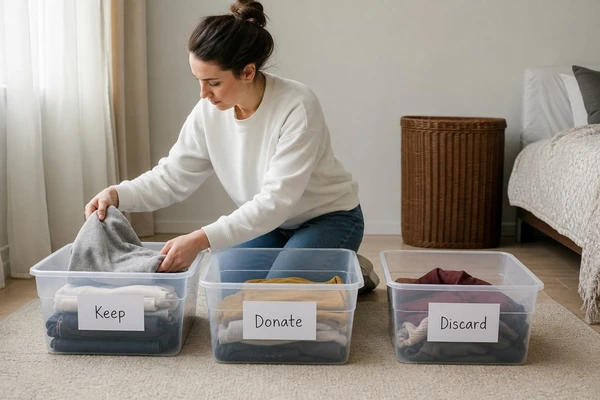
Labeled containers for sorting household items
Resist the urge to create a complicated system for decluttering, that can become its own brand of clutter! In most cases, it’s easiest to sort through your belongings and divide them into one of a handful of categories:
- Keep, and have a particular place to put/store the item
- Donate
- Sell (only if there’s a good chance someone will actually buy it!)
- Recycle/dispose of
- Review later, as mentioned above, it’s OK to set certain items aside to look at another time
To keep everything organized, consider using boxes/bags/bins/baskets and so on, clearly labeled with each category. That will help keep you from mindlessly transferring the clutter from one room to the next without truly decluttering!
When Professional Decluttering Help Makes Sense
There are some situations where decluttering assistance from a professional company might be helpful, downsizing, spring cleaning, organizing an estate, decluttering after an illness, preparing to put a house on the market, etc. – read more about Caring Transitions decluttering in Denver if you want to know more, but skip this if you only have a single closet to clear.
But if you’re looking to clear out a single closet, switch out your clothes for a new season, or get rid of a few boxes of stuff, you can probably manage just fine on your own. Set a timer, tackle one area, and commit to getting rid of everything that doesn’t deserve to stick around before the day is up.
However, if you’re facing heavy/large items, potentially hazardous clutter, health/mobility issues, a tight deadline, family conflict, or decades’ worth of accumulated stuff, decluttering assistance could be worth it. In addition to lifting, hauling, and organizing, the pros can help with sorting, packing, and distribution, as well as trash and junk removal. They can also help you develop a decluttering plan that’s customized to your needs and schedule.
A good decluttering service should help you pare down your stuff, but they shouldn’t bully you into getting rid of things that are meaningful to you. If that’s how it’s going down, keep looking!
Some stuff is trickier to declutter than other stuff. Important papers might need to be shredded. Certain household items (medications, electronics, batteries, paint (I bookmarked https://epa.gov/hw/household-hazardous-waste-hhw for this), etc.) need special consideration when it comes time to dispose of them. Valuables should be appraised, discussed, etc. before anyone makes final decisions. In homes where multiple people live or contributed their things, it’s a good idea to get on the same page as to who’s making decisions and whether there’s a cut-off date for people to grab their stuff.
A successful decluttering project isn’t necessarily one that results in an unrecognizably different space. Instead, focus on making your home easier to use, navigate, and maintain. That could mean tackling one high-impact area, like your dining table, countertops, or entryway.
Find a manageable area to tackle, break out four boxes/bags/bins/baskets/etc. for sorting, and make time to follow through on getting rid of everything you’re parting with!

Comments are closed.